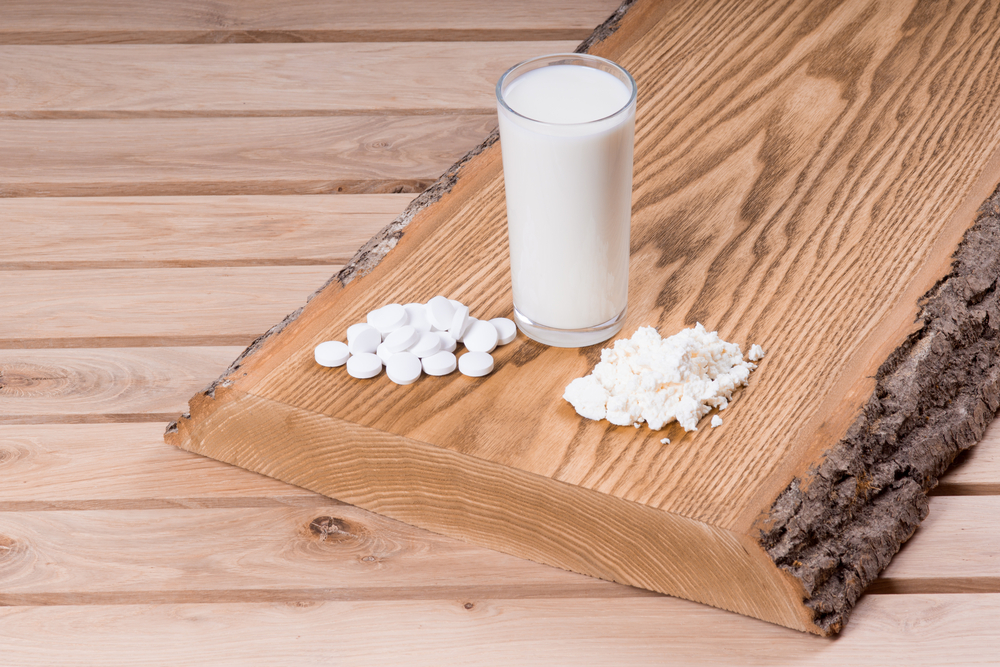
This report is aimed at those who wish to learn more about dietary supplements containing the active ingredient lactase. Whether it’s you yourself who suffers from lactose intolerance, you know family members or friends who do or you are just interested in the topic, below you will find all the information you need to find the right lactase product.
A lactase compound- what’s that?
Lactase compounds are dietary supplements which contain the enzyme lactase. This is an enzyme which is produced in the small intestine and is responsible for breaking down the components of milk sugar (= lactose). Lactose intolerants are people whose small intestine cannot produce enough lactase for this. The consequences are that, after consuming products containing lactose, the person affected suffers from the most unpleasant symptoms such as nausea and feelings of faintness, and also suffer from bad diarrhoea, which can lead to rapid weight loss. Through the consumption of lactase compounds it is possible, however, to largely offset this lack of naturally produced lactase. In many countries in the world, for example in Asia, people only have the ability to produce enough lactase when they are children and as adults are almost 100 percent lactose intolerant. Even though -thanks to evolution- Europeans have a better tolerance to lactose, around a quarter of the population have problems with foods containing lactose.
How is lactase supplied to the body?
Lately many dosage forms have become available, in tablet, capsule and even powder form. The most practical and effective have been found to be the chewable tablets.
The production of artificial lactase
As mentioned, it’s all about the enzyme lactase, which the human body produces by itself. For lactose intolerants, this enzyme is no longer produced by the body itself and must therefore be supplied from an external source. The fact that lately a whole food industry to do with the production and distribution of lactase compounds exists, shows that lactase is producible on an industrial scale.
In principle there are different ways of manufacturing lactase. The common production process is to stimulate the fungus Aspergillus oryzae or even the yeast fungi Kluyveromyces fragilis and Kluyveromyces lactis in a retort so that they produce lactase.
Sometimes packages of some preparations can be misleading as they note that it constists of „lactase in drug quality“ or „natural lactase“. What initially sounds quite positive, however, turns out to be an advertising ploy – the lactase in such products cannot be differentiated in this way from any other forms, since they are obtained by using the fungus Aspergillus oryzae as described above.
What additives are in it?
The next question may be interesting for many people: What additives are in the lactase compounds? It is true that every lactase products are also always bound with auxiliaries and additives. This is usually done so that the lactase can be easily absorbed in the body, so that it does not clump or mix too much with food. But different coloring agents (such as titanium dioxide) and sweeteners are often added. The authorization of which is highly questionable from the perspective of modern research and may even be harmful. For instance, studies have shown that sweeteners such as sorbitol and xylitol made some intolerance problems worse. In order to keep the concentration of such undesirable additives as low as possible, it is advisable to buy more expensive products, since these generally have only low doses of unwanted filler, although exceptions are possible.
Comparison of the active ingredient content with other compounds
The amount of the active ingredient in lactase products is measured in the unit „FCC Units“, which is the abbreviation for Food Chemical Codex. Time and time again, false information can be found on the internet as to the effect of different dosages. One commonly made presumption is the fact that 1000 FCC units are neccessary to break down 5g lactose. We know from clinical tests that three to five times the dose is necessary. So for the consumption of 200ml milk you’d need between 6,000 and 10,000 FCC-Units (why? see the heading ‘Dosage’)
Costs of lactase products
A favorable indicator of the price of a lactase product is in the potency. For example: One producer from Germany sells 100 tablets with 3,000 FCC units for 30 euros. At the same time foreign competition offers a similar product for 26 euros, which includes also 100 tablets but only half of the active ingredient content, i.e. 1,500 FCC units. In this case the more expensive product would be the first choice as only for a little extra money you get more active ingredient in the tablets.
However, a positive trend in the the active compound concentration of numerous preparations can be observed- as many manufacturers proceed to expel higher dosage products that include 12,000 or 15,000 FCC units. So the consumer can play it safe and consume products containing lactose without having to do all the math.
In fact there are products where no active ingredient content is given, in this case you would take the risk that you buy a pig in a poke, which of course we advise against.
Health Insurance Reimbursement
To put it bluntly: In Germany health insurance does not cover the cost of lactase products. The reason for this is that the products in question are food supplements and not medications. While some manufacturers try to declare their products as ‘pharmaceuticals’, it does not alter the legal status of lactase preparations, which is defined solely by national legislature. Therefore until now there has not been a known incident where medical insurance has covered the expenses.
Where do I get lactase products?
In Germany compounds containing lactase are distributed as dietary supplements and are therefore available at chemists, drug stores and health food stores without prescription. Of course they can also be ordered on the internet, which makes sense particularly when you want to try products from abroad, which are not sold in Germany. When doing so, it is important to take a close look at the active ingredient content, the additives as well as the source.
Frequency of Dosage
Even though lactase compounds allow you, in principle, to consume milk sugar, you should still keep in mind that they do not account for a one hundred percent replacement for the body’s own lactase. People who are lactose intolerant should therefore try to keep their milk sugar consumption to a minimum if possible. For situations where you can’t avoid consuming milk sugar, it is important to have a lactase compound to hand, otherwise you’ll quickly start to feel the unpleasant implications. Of course, some manufacturers are of the opinion that their products could completely substitute endogenous lactase, but it stands to reason that economic interests rather than solid research results underlie such statements.
Ways of ingesting the supplements
Be aware that lactase can only take effect when it reacts with milk sugar in the intestines. Unlike most drugs, which build a certain concentration in the body when taken regularly throughout the day, the consumption of lactase preparations makes no sense if you are not going to eat any lactose-containing foods. It is recommended therefore, to supply the body with lactase before a meal,
so that it reaches the intestine before the milk sugar. If you spend a long time eating, such as in a restaurant or at a banquet, you should not hesitate to take some more lactase. For hotter foods over 40 degrees celsius, there is admittedly the problem that the lactase can no longer work to its full potential- so be careful to avoid such circumstances by not sprinkling lactase over hot food. After the meal a concentrated amount of lactase doesn’t have any further benefits- it really only works as long as it can react with lactose.
Dosage
For a long time has been considered the rule of thumb that 1,000 FCC units is sufficient to break down 5g lactose, which is about one 100ml glass of milk. This ratio was based on laboratory tests in which the measurements used watery solutions. The advantage of this method was that lactase and milk sugar react well together in principle in this condition and the breakdown of the lactose is usually largely successful. The experiences of many lactose intolerants have, however, lead to the general recognition that these amounts are unequivocally too small. As in fact far larger concentrations of lactase are neccessary to break down the given amount of whole milk, which is because the watery solutions just don’t have the same consistency as the partly thick, pulpy acidic fluid which passes from the stomach to the small intestine, in which the reaction of lactase and milk sugar is bound to be more difficult.
Unfortunately it is not often possible to know the exact milk sugar content of a food product; what is also complicated is that efficiency depends on the temperature and also on the food’s consistency – thick liquid food products therefore always need more lactase in order to break it down. All things considered, you should always go in with the mindset that ‘too much is better than too little’, when using lactase supplements.
As mentioned, the modern preparations with very high concentrations of 12,000-15,000 FCC units have ensured just this, however you absolutely must pay attention to the contained additives (hier applies: always go for less additives).
To be on the safe side, before a mealtime you should consider therefore taking a dosage of 14,000 FCC-Units, to which you then add another 7,000 FCC-Units around an hour later- should the meal stretch out over a longer time period. As long as none of the above-mentioned sweeteners are contained in the compound, an overdose of lactaseis not a risk, since high concentrations in the body are not toxic. If you don’t take enough lactase compound however, it is not possible to retrospectively alleviate the symptoms by an increased intake of lactase supplements. Once you know what you’re dealing with (have eaten a meal already a few times using a high dosage of lactase), there is nothing to stop you slowly reducing your intake, as long as no problems arise. As always it’s better to be safe than sorry. 😉
Legal basics
Unfortunately in the lactase products business there are some uncertainties, which legislative authority has not yet ironed out. Although, as mentioned, the lactase compounds have the clearly defined legal status that they are not drugs but food supplements, numerous manufacturers try by any means to give the impression their product is a pharmaceutical drug. As a consequence there is completely different terms and definitions on different packaging which, in the end, all contain the same active ingredient. Something to think about: It does not matter whether they are described to be “dietary supplements“, “food products“, „food additives“ or “pharmaceutical drug”, they are all lactase compounds. Particularly for new customers this ambiguity can be a nuisance, because such subtelties can make you lose track of where you are and choosing the right supplement can be difficult if not impossible.
Final remarks
Lactase compounds offer a the chance to consume milk sugar without getting the uncomfortable and unpleasant usual symptoms of lactose intolerance. But yet: Even the best lactase product is not designed to completely substitute for lactase produced in the body. This doesn’t change the fact that countless manufacturers think the opposite. The best way to get through life without these complications is just to do your best to avoiding consuming milk sugar. Only when you cannot avoid eating lactose containing foods should you rely on lactase supplements. When choosing the right product, you should pay particular attention to having a very high dosage and with the lowest possible concentration of sweeteners and other additives are not necessary; considering this, cheaper products should be avoided.
If you manage to follow these tips, you should easily be able to benefit from the advantages of lactase supplements, introduce them into your life and thereby make life easier for yourself.
0 comments on “Lactase compounds- an introduction”Add yours →